I know I have been rather absent this month, so I do apologize!
I think my only reasoning behind it is that it's been very busy at my day job (because of course genealogy is my night job!! haha) and also I had a few party events this month and some meetings with friends, which in a good way, took a bit of time from focusing on my blog.
The month of May could look even bleaker with my posts. The main reason being is that I will be on vacation from May 11th through May 22nd in Florida. It should be a very good time :)
I may create some posts and delay their publication so my blog doesn't look like I abandoned it over the last two months. I will see what I can fit in before I head off.
Until then - Happy Blogging fellow genealogists :)

Thursday, April 30, 2015

Sunday, April 12, 2015
Ancestry DNA - Test Results
About a little over a month ago, I had written a blog about getting tested through AncestryDNA. I have been evaluating it for years, but the price was always out of my spending range. When it got into the $99 range, it seemed to make more sense to give it a whirl. So, being that I couldn't take it any longer, I finally purchased the test and went through the motions of getting it completed (as I detailed in a previous post).
Firstly, it took about 4 1/2 weeks. I am assuming this was a non-peak time to take the test as I did it a few weeks after the holidays. Other genealogy blogs said it took theirs longer due to the surge of Christmas purchases of DNA tests. So, it looks like late January - early February is a nice time to sneak one in and get it done quickly.
Here is a breakdown of the pros and cons:
Ethnicity Estimate & Ethnicity Map - Score - 8 out of 10


At first, this seems pretty awesome. You see lots of faces pop up on the page beside your Ethnicity Estimate and Map which give you an impression of the many people you may be related to, on what seems a pretty high confidence level. However, as you click on the link to check them out, it becomes obvious that you've got your work cut out for you. I looked down at how many pages I was going to have to go through - 78 pages of possible cousin matches!! This could take me years. But, I was still excited about these connections and started clicking on several of them to see how we could be connected.
Some connections were very obvious due to the DNA Circles (I will move onto this topic next) and some you could only really connect through a common surname in your trees by clicking on their name and then seeing the surnames you're connected with. What was really strange is several surnames were shared between us as cousins and they were both from my mother and father's trees. So, this got me a little tripped out - Is AncestryDNA only really connecting us by how many surnames we share? It seemed to be the case. I found this to be a little weak for what DNA is really supposed to offer. If we're related through DNA, that's what I want to know! Not how many surnames we share! I am sure that could easily be figured out without my DNA sample.
DNA Matches are a bit of a help and in some ways a bit of a hindrance. I think in some ways they help because in one way or another you're connected and that's pretty cool! But, in other ways, it's not of a huge help if you have 78 pages of possible cousins that are not very well outlined as clear-cut connections. There is no description of how you're connected and what kind of DNA got you two to that connection.
Other reviewers of AncestryDNA also start to get frustrated at this level. I can understand this frustration. We are paying a fairly hefty price for some invaluable and unique information (selling our soul, so to speak) and yet AncestryDNA has dumbed it down so much that even the newbies are going to feel like they are getting less than what they paid for.
I am not really super, super savvy with everything that DNA entails, but something called a chromosome browser sounds like a great idea - however, I would need to know how it worked. Since AncestryDNA is not offering it (yet), it sounds like researching your own DNA to connect it with others is going to be done the Ancestry way - cousin matching and shaking leaf hints.
I am sure if AncestryDNA created a user-friendly chromosome browser and explained it's usefulness to members, it would become the norm on how we can make our connections and actually make our DNA information even more priceless and useful. I think people who take the DNA test want to learn more behind the actual DNA (what's it made of, give us a visual sample of how our DNA looks, show on a strip how we connect to another person and what makes us similar), not that they only have a 150 new cousins.
DNA Circles - - Score - 6.5 out of 10
As you scroll down, there is an area called DNA Circles. This allows you to see how many people you share common DNA based on people that you share in your family trees. It's actually one of the more interesting and better features that AncestryDNA offers, although, it is best to verify these matches with various approaches (such as filtering your DNA matches with the shaky leaf hint option). You can click on the various DNA Circles (I only have 6 at the moment) and see how many people are connected to the same ancestor as you.
IMPORTANT: It is best to remember that AncestryDNA may be connecting you with these people solely on fact that you have the same people in your trees. It would be best to cross reference these connections to ensure that you do indeed have a true connection.
The DNA Circles are innovative but once again, without not being able to verify your Chromosomes through a Chromosome browser, these connections cannot be truly verified unless you can ensure your trees match based on verifiable records.
----------------------------------------
Overall Score - 6.5 out of 10
I think the technology of DNA testing for genealogy, although it's come a long way, still has a long way to go. I was hoping for a little more help from Ancestry.com on how to navigate and get around these things, especially with all the available tools that some other sites are already integrating. I really feel AncestryDNA can really benefit by adding more analytic tools for the results and let us explore based on these tools. Any really good and thorough genealogist is not going to accept their results and likely matches as the real deal unless they have the hard data to prove it. So, give us a little more credit and please give us what your peers are already offering.
Firstly, it took about 4 1/2 weeks. I am assuming this was a non-peak time to take the test as I did it a few weeks after the holidays. Other genealogy blogs said it took theirs longer due to the surge of Christmas purchases of DNA tests. So, it looks like late January - early February is a nice time to sneak one in and get it done quickly.
Here is a breakdown of the pros and cons:
Ethnicity Estimate & Ethnicity Map - Score - 8 out of 10
For me, the most surprising was finding how much Scandinavian blood I carry in me. It must be mostly from my British ancestors. Even my last name is of Danish origin, although we have no immediate Danish family members. I also was slightly disappointed of not carrying any Native American in me, although it's been mostly confirmed that we have it in our family. My great grandmother was even born in the Cherokee Nation capital. So, I guess my genes just decided to skip out on giving me any Native American. Ah well!
However, what I gained in my Trace Regions made me excited. Even though these "traces," as they call them, are not really saying you are actually of this ethnicity, it is still an interesting part of your make-up that shouldn't be ignored. What it seems to help confirm is that some of the surnames we carry have origins in these areas. A surname I recently highlighted in a previous post of mine (Orth), has strong origins in Spain, which could explain why I have some deep-rooted Iberian ethnicity in me.
The Italian/Greek in me is the strangest one of them, though. Not strange because it's a strange ethnicity to have, haha. But because it was the least expected finding I would expect.
I often thought that my grandmother's maiden name sounded like "Rome" and I have read theories on the surname, Roehm - that it likely meant that they came from Rome. This is somewhat far fetched and is only speculation, but it is a fascinating thought. I like what the exotic Trace Regions have brought to my genealogy.
All of this information has helped me feel more connected now and help answer (and confirm) where I really am from.
The Ethnicity Map is fun to look at and see just how broad of an area your DNA covers. It goes to show how nomadic our people were (and still are).
Overall, this portion is by far the best first impression you get once you receive your results. And, it's a great impression of what AncestryDNA is offering up. After this, though, it begins to get a little unnerving.
DNA Matches - Score - 5 out of 10
Some connections were very obvious due to the DNA Circles (I will move onto this topic next) and some you could only really connect through a common surname in your trees by clicking on their name and then seeing the surnames you're connected with. What was really strange is several surnames were shared between us as cousins and they were both from my mother and father's trees. So, this got me a little tripped out - Is AncestryDNA only really connecting us by how many surnames we share? It seemed to be the case. I found this to be a little weak for what DNA is really supposed to offer. If we're related through DNA, that's what I want to know! Not how many surnames we share! I am sure that could easily be figured out without my DNA sample.
DNA Matches are a bit of a help and in some ways a bit of a hindrance. I think in some ways they help because in one way or another you're connected and that's pretty cool! But, in other ways, it's not of a huge help if you have 78 pages of possible cousins that are not very well outlined as clear-cut connections. There is no description of how you're connected and what kind of DNA got you two to that connection.
Other reviewers of AncestryDNA also start to get frustrated at this level. I can understand this frustration. We are paying a fairly hefty price for some invaluable and unique information (selling our soul, so to speak) and yet AncestryDNA has dumbed it down so much that even the newbies are going to feel like they are getting less than what they paid for.
I am not really super, super savvy with everything that DNA entails, but something called a chromosome browser sounds like a great idea - however, I would need to know how it worked. Since AncestryDNA is not offering it (yet), it sounds like researching your own DNA to connect it with others is going to be done the Ancestry way - cousin matching and shaking leaf hints.
I am sure if AncestryDNA created a user-friendly chromosome browser and explained it's usefulness to members, it would become the norm on how we can make our connections and actually make our DNA information even more priceless and useful. I think people who take the DNA test want to learn more behind the actual DNA (what's it made of, give us a visual sample of how our DNA looks, show on a strip how we connect to another person and what makes us similar), not that they only have a 150 new cousins.
DNA Circles - - Score - 6.5 out of 10
As you scroll down, there is an area called DNA Circles. This allows you to see how many people you share common DNA based on people that you share in your family trees. It's actually one of the more interesting and better features that AncestryDNA offers, although, it is best to verify these matches with various approaches (such as filtering your DNA matches with the shaky leaf hint option). You can click on the various DNA Circles (I only have 6 at the moment) and see how many people are connected to the same ancestor as you.
IMPORTANT: It is best to remember that AncestryDNA may be connecting you with these people solely on fact that you have the same people in your trees. It would be best to cross reference these connections to ensure that you do indeed have a true connection.
The DNA Circles are innovative but once again, without not being able to verify your Chromosomes through a Chromosome browser, these connections cannot be truly verified unless you can ensure your trees match based on verifiable records.
----------------------------------------
Overall Score - 6.5 out of 10
I think the technology of DNA testing for genealogy, although it's come a long way, still has a long way to go. I was hoping for a little more help from Ancestry.com on how to navigate and get around these things, especially with all the available tools that some other sites are already integrating. I really feel AncestryDNA can really benefit by adding more analytic tools for the results and let us explore based on these tools. Any really good and thorough genealogist is not going to accept their results and likely matches as the real deal unless they have the hard data to prove it. So, give us a little more credit and please give us what your peers are already offering.
Friday, April 3, 2015
Follow Friday - Elyse's Genealogy Blog
I am generally akin to genealogy bloggers who follow these guidelines:
1) Posts often
2) Posts thought provoking/inspiring topics
3) Does not lose you as their reader while writing too much about facts
4) Varied topics throughout blog
5) Friendly demeanor
Maybe because I try to blog in a similar fashion, I tend to follow bloggers who write in a similar way.
With that, I thought I'd introduce my first "Follow Friday:"
Elyse's Genealogy Blog
http://elysesgenealogyblog.com/
Why I like it: This is a very well done blog. It's not so flashy that you get lost and distracted. She writes in a very honest matter and yet gets the point across. Again, many genealogy blogs can get so lost in the "facts" that they can become tiresome to read. Well written blogs are meant to be thought provoking and interesting. Elyse does a very good job of keeping that balance. She also gives insight on how to search and get through brick walls (i.e. her most recent 3/31 post)
Genealogy blogs should inspire us to want to re-examine our way of thinking and try a new route. I think Elyse does a great job of this. I like how she also brings in photos. For me, the photos, illustrations, etc are huge drawing points for people. But, this is just a personal preference.
Overall, I really like this blog and I highly recommend it.
1) Posts often
2) Posts thought provoking/inspiring topics
3) Does not lose you as their reader while writing too much about facts
4) Varied topics throughout blog
5) Friendly demeanor
Maybe because I try to blog in a similar fashion, I tend to follow bloggers who write in a similar way.
With that, I thought I'd introduce my first "Follow Friday:"
Elyse's Genealogy Blog
http://elysesgenealogyblog.com/
Why I like it: This is a very well done blog. It's not so flashy that you get lost and distracted. She writes in a very honest matter and yet gets the point across. Again, many genealogy blogs can get so lost in the "facts" that they can become tiresome to read. Well written blogs are meant to be thought provoking and interesting. Elyse does a very good job of keeping that balance. She also gives insight on how to search and get through brick walls (i.e. her most recent 3/31 post)
Genealogy blogs should inspire us to want to re-examine our way of thinking and try a new route. I think Elyse does a great job of this. I like how she also brings in photos. For me, the photos, illustrations, etc are huge drawing points for people. But, this is just a personal preference.
Overall, I really like this blog and I highly recommend it.
Tuesday, March 31, 2015
Preserving Old Family Photos - Part 1

Possibly 130 Film Negative - Medium Format

220 Film Negative - Medium Format

126 Film Negative - Medium Format (barely)
Being the family historian is one thing, but also being one of our photographer's in our family is a whole other madness. I love taking photos. I have been taking them for years but bought my first real serious camera in 2009, a digital SLR by Nikon. I have used it to capture so many events and portraits; babies stuffing their faces with cake; weddings; graduations; baby showers and many travels. It's documented so much of who I am. I'd be lost without it.
While photographing all these great current events and times will leave a rich and colorful footprint for my future ancestors, some may not fully understand how photography plays a very large role regarding genealogy and our past ancestors. Probably the most precious of items while researching your family history is having a photo of your ancestors. It changes the game in a completely different way and breathes life into your research.
Photography is still a new technology, in genealogical terms. It goes back roughly 170-180 years, so at most, and if we are lucky, we could have a photograph of an ancestor from possibly the 1840's an onward (photography had been around slightly earlier, but the likelihood of any of them surviving are very far and few between - and if they did survive, they could be in a museum). That means if that ancestor was in their 60's, 70's or 80's then probably the oldest photographed ancestor would have been born in 1760-1780. It's remarkable that we could have a photograph of someone who was born in the 1700's.
If you do have a photograph this old, it is more known as a Daguerreotype or a tin type.These were the most popular types during the 1840's through the 1860's. The tin type was used more frequently after the Civil War and into the early part of the 20th Century. Silver gelatin prints on paper (or glass) then became more popular during the early 1900's and lasting throughout the 1930's and 1940's. Regular prints with ink, as we known them today, are what people have been using since the 1940's and onward, especially with the advent of more user friendly cameras like the Eastman Kodak "Brownie" camera, which were very popular up until the 1960's.
Of course there have been other methods of photography that people have used during a slight surge in popularity due to novelty reasons, for example:
- Polaroids
- Photo Booth photos
- Single Lens Reflex (SLR) camera photos (for the more intermediate photographer in the family - these were mostly 35mm)
- Kodachrome film photos (these photos were known to capture vibrant colors during the 1930's up until it's demise in 2009)
- Slides (Nowadays these often are converted into photos in order to preserve them)
Due to certain cameras and the kind of film they used, you may hear of terms such as medium format and large format. You may also come across negatives that are much larger than your more common 35mm and 110 film negatives (widely used during the 1970's throughout the 1990's).
Negatives that are medium format are what you see throughout the early 1900's up until the 1960's - These often included 120 and 220 film #'s.
Negatives that are large format are what you see throughout the late 1890's and part of the early 20th century (they were very large, imagine them being about the size of a 5x7 or even an 8x10 photo). Think of the very crisp Ansel Adams photographs you often see. Those are from large format cameras. They took incredible photographs and the clarity can't be beat, even in our current digital era.
Now that we have a very brief understanding of the film types and formats, including the very popular cameras of the last 180 years, lets bring ourselves to present in how we should handle these remarkable (and fragile) pieces of history.
In my next post, we will discuss handling and storage techniques of negatives, ways to "develop" them that are cost effective, and how to "invert" the image so it's now a positive image.
Now that we have a very brief understanding of the film types and formats, including the very popular cameras of the last 180 years, lets bring ourselves to present in how we should handle these remarkable (and fragile) pieces of history.
In my next post, we will discuss handling and storage techniques of negatives, ways to "develop" them that are cost effective, and how to "invert" the image so it's now a positive image.
Monday, March 30, 2015
Fearless Females - {Birthday Edition}: Lydia Herr Roehm Murphy - Born March 20th - Part 3
Lydia's life was already so full of good times with friends and family, you would think that nearing 80 years old, she might have said to herself "I think I will take a rest." But, Lydia didn't quite understand what rest meant. I believe her to be a restless soul. Constantly full of many interests and hobbies.
During the 1960's she took up many new hobbies - one was as cake maker and designer. She made many event wedding, birthday, christening/baptism, and various other cakes. She made a lot of her grandchildren's wedding cakes, often very large and opulent ones.
She also became interested in "rock hound" activities, befriending a townswoman in Brentwood who collected rare rocks.
After Bill Murphy's passing in May of 1973, Lydia had even more free time on her hands. Only living on her own on a very large ranch, Lydia lived in her own home until the early '80s, until she moved in with her daughter Annette.
But, between the early 1970s and early 1980s, Lydia and Annette would travel all over the US and even to Hawaii (even though Lydia's motto was always that she thought your feet belonged on the ground, she still took a chance and flew).
Here are some photos during this time:


Source: Visit Lisa Alzo's great blog, which is the source for the Fearless Female blog prompt, http://www.theaccidentalgenealogist.com/
During the 1960's she took up many new hobbies - one was as cake maker and designer. She made many event wedding, birthday, christening/baptism, and various other cakes. She made a lot of her grandchildren's wedding cakes, often very large and opulent ones.
She also became interested in "rock hound" activities, befriending a townswoman in Brentwood who collected rare rocks.
After Bill Murphy's passing in May of 1973, Lydia had even more free time on her hands. Only living on her own on a very large ranch, Lydia lived in her own home until the early '80s, until she moved in with her daughter Annette.
But, between the early 1970s and early 1980s, Lydia and Annette would travel all over the US and even to Hawaii (even though Lydia's motto was always that she thought your feet belonged on the ground, she still took a chance and flew).
Here are some photos during this time:
One of Lydia's big and beautiful cakes at my Aunt Penny's Wedding, circa 1969, at Wiebel Winery.
Lydia, (Aunt) Diane, (Gr. Aunt) Izetta and her daughter Cindee, (my mom) Carole and (step-great grandfather) Bill Murphy, circa 1967
Carole, Bill Murphy and Lydia, at Annette's home in Fremont, CA, circa 1969-70.
Joyce, Izetta, Annette and Lydia cutting a cake at Lydia's house, circa 1968-69
Annette, Lydia and Izetta at Lydia's home, circa 1970-71
Lydia at her daughter Annette's home, circa 1974-75
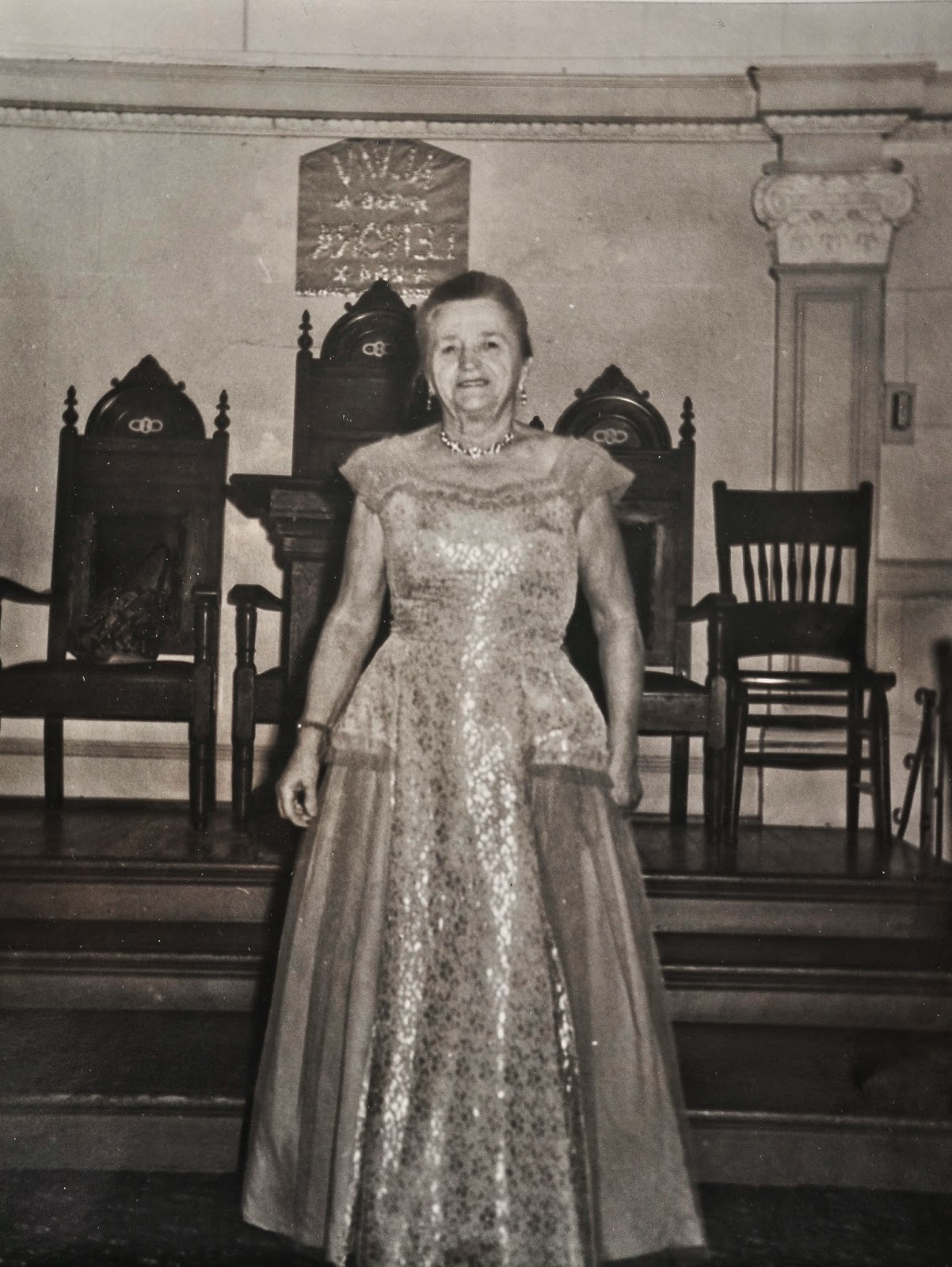
Lydia and Mrs. Edith Ordway (at Edith's home in San Francisco), circa 1978
Lydia with all of her grandchildren (and great grandchildren) from daughter Annette, circa 1979
Annette, Lydia and Viola Schubert, circa 1981, in Washington state
The 1980's saw Lydia slowing down a little more. In 1981, she was diagnosed with coronary artery disease. Even still, she still made attempts to attend birthdays, weddings, and any other parties.
On a personal note, I only remember Lydia just a few times. I remember her coming to our house when I was maybe 4 or almost 5. My Grandma was bringing her over to visit, but it was a short visit. Lydia seemed so regal to me. My Grandma would do up her hair into a beautiful bouffant cloud of white hair and would always dress her up nicely. She looked like a queen. She just needed a crown.
I don't really remember Lydia's passing as I was just about to turn 5 years old when she passed away on May 4th 1987. The details surrounding her death left my Grandma heartbroken. My grandma (Annette) took her to our local hospital because Lydia was having breathing issues. They hospitalized her for a few days and said she had a UTI. The night Lydia passed away, the doctor's assured my grandma that Lydia would make it through the night, so she (and other family members) went home, with a bad feeling in their stomachs. One part I need to confirm is that Lydia either yelled out my Grandma's name as she left or murmured it as she passed away. Lydia's time of death would be 4am on May 4th 1987.
With Lydia's death, there was the strength of a matriarch in our family that was now missing. Her daughter, Annette, has carried on the torch to take care of the ranch and live out the rest of her days there. But, until this day, my Grandma mourns her mother's death, even at the age of 86, she still feels lost without her.
Thank you, Great Grandma Lydia for being a rock in our family, making wise decisions and for your loving heart. You are not forgotten.
Lydia and Annette, circa 1985
Lydia at the ranch, circa 1981
Source: Visit Lisa Alzo's great blog, which is the source for the Fearless Female blog prompt, http://www.theaccidentalgenealogist.com/
Sunday, March 22, 2015
Fearless Females - {Birthday Edition}: Lydia Herr Roehm Murphy - Born March 20th - Part 2
Lydia's life, in retrospect, may have not had a lot of impact in the sense that she won an Academy Award or the Nobel Peace Prize, however, she did impact many people's lives who loved and adored her.
Moving to California after living 46 years of her life on the Great Plains must have had to have been a big transition. Interestingly, many of her children had already moved to California, presumably for more work. The only child of hers that remained in North Dakota was Doris, who stayed back with her husband and daughter, but would visit California occasionally. At one time, Doris did live out here and had a job working for the Kaiser shipyards as a secretary, but it appears she went back with her husband and child to live in Valley City, ND.
When they traveled to California, Lydia had all of their furniture and large items shipped by train. They then paid a friend $700 to drive them to California. Annette (my grandmother), said she had to leave many items behind when they moved, including one of her favorite dolls.
On their way to California, the car finally gave out in Idaho and they had to get it repaired. Their friend who was driving them, who had little money, looked to George and Lydia to help pay for the cost of repairs, and so they did. Finally, they got to California. They had to live with their daughter Izetta for a few months before their home in Richmond was completed. Once the home was completed, Lydia and George were amazed to have indoor plumbing, a true luxury for those who came from the Great Plains to a metropolitan city. It was a brand new home and Lydia wanted to keep it that way. Annette recalls her father used to get so dirty working in the shipyards, that when he'd take a bath, he'd leave rings in the bathtub and Annette would have to scrub them out.
Making the move more complicated, Lydia was pregnant with her last born. He was born in November 1942, sometime after they came out to California. When James Roehm was born, he had Down Syndrome. Back in those days, this was often misunderstood. Unfortunately many babies born with Down Syndrome were institutionalized. At the doctor's urging, George and Lydia were advised to do just this with their newborn. Lydia refused to put him into an institution and so they took their baby home.


George and Lydia continued to raise their family, which now only consisted of daughter Annette and James Roehm. Annette left home right after her high school graduation from Richmond Union High School in 1947 and married Frank Connors of El Cerrito, CA, son of Frank Sr and Annie (Bridget), a popular and fun-loving Irish-Catholic family in the El Cerrito/Berkeley/Albany area.
In 1948, George Roehm suffered a heart attack while working in Linden, CA, with his daughter's father in law, Bruce Purviance. His heart attack proved fatal and he died two days after his birthday on October 18th, 1948.
Lydia continued to live in Richmond, but I am sure there was a sense of loneliness inside of her, despite the fact that she was involved in many groups and clubs, especially the Rebekah lodge. Now that her youngest daughter was married and had children of her own, Lydia had to raise James alone.
Sometime after, Lydia started going out again and living a little. She went to some dances in Richmond and Oakland. At these dances, she met a man named Bill Murphy, who was living in Oakland, with his mother, who also had passed on around this time, in 1949. Bill was likely helping take care of his mother, along with his siblings, whom some also lived in the area. Bill was a confirmed bachelor. He never had married (that we are aware of) and did not have any children.
By meeting Bill Murphy, Lydia's life would take on a whole new twist. Not only was Bill Murphy a nice and gentle man, but he also owned lots of land in the town of Brentwood, land that was very valuable to the area. Lydia and Bill were married in 1950. With this marriage, Lydia had to leave behind her home in Richmond and move to the country with Bill. However, Bill let her design her own home and let her have it built custom to her own specifications. The home was completed around the end of 1950 and 1951.
From now on, Lydia was not without want. She was going to be well taken care of, and the kindly Bill Murphy also took on in helping raise James.
With a new home and beautiful land to wake up to everyday, Lydia was not one to keep this to herself. She opened her home to all. She had a basement that was as large as the main house floor, which is where she'd often invite all her children and grandchildren, cousins and nieces and nephews, sisters and brothers - and of course, her lodge friends. Also, as she got more familiar with the area, she quickly became good friends with the locals. There were a few fun eccentrics living nearby her. One was Mrs. Edith Ordway. Mrs. Ordway was a wealthy San Franciscan who purchased land in the Los Vaqueros area (behind the Black Hills of where Lydia lived). However, Mrs. Ordway loved to play cowgirl and shoot off her rifle when she had the chance, you know, just for fun.

Another family she also befriended were the Cakebread family. The Cakebreads owned land near Lydia and became close to her as well.
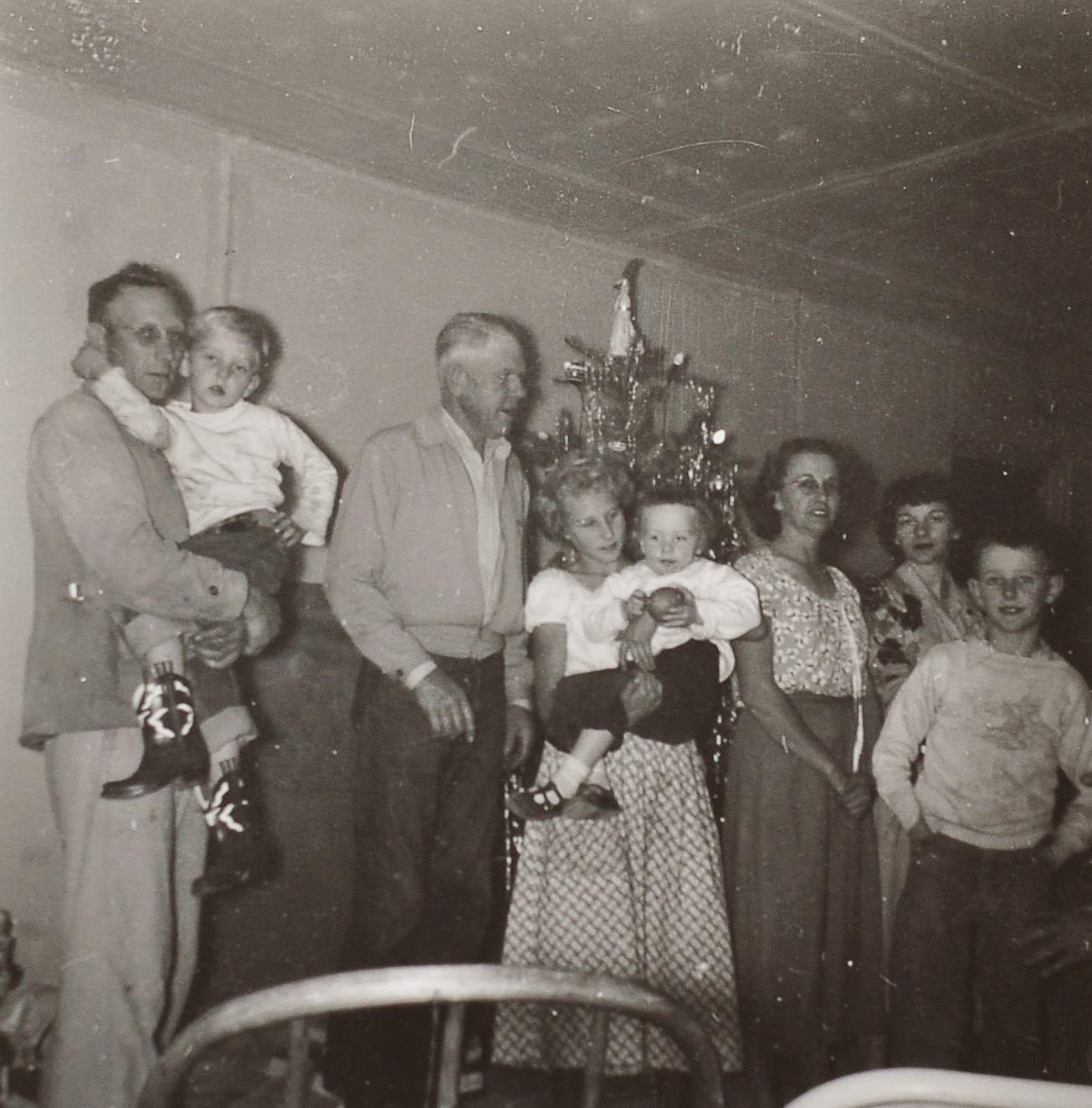
The following photos demonstrate that parties were even happening before the house was finished, circa 1951 (note the plaster on the drywall and unfinished windows).
 Ross Sr, Ross Jr., Alberta Roehm, Bud Wolf, Diane Connors, Frank Connors, Penny Connors, Annette Connors. Front: Ronnie Wolf and Vernette.
 Bill Murphy, Lenora Roehm, Lydia Roehm, Hank Wolf, Alwin Roehm, Frank Connors (standing), Ross Sr (smoking) and Penny Connors with Vernette Roehm.

When Bill and Lydia lived on the ranch together, Bill took care of the Ranch, using the tractors and corralling cattle, keeping chickens in the coops, maintaining the old big Barn, the tack house, bunk house and various other duties of the land. Lydia settled into a somewhat retirement, taking up new and enjoyable hobbies - learning to cook and design complicated cakes and decorating them herself. Her wedding cakes were used in both my Aunt's and mother's weddings. They were some of the most elaborate wedding cakes I ever saw. Lydia also enjoyed selling greeting card sets that she mail ordered. She hung onto many of the sets that never got sold.
During this time, Lydia also started to travel outside of California more. She went back to North Dakota several times to visit with her family and her daughter, Doris, who had recently been diagnosed with Multiple Sclerosis. Doris would pass on in 1963, at the young age of 48.

 Visiting Doris in Valley City, North Dakota, having a picnic, July 1959. Lydia is second from right.

When not traveling, Lydia was highly involved with the Byron and Rio Vista Rebekah lodge orders. Even her children would get involved, but she was the most involved of them all - and she had a strong group of friends because of this.



Source: Visit Lisa Alzo's great blog, which is the source for the Fearless Female blog prompt, http://www.theaccidentalgenealogist.com/
Moving to California after living 46 years of her life on the Great Plains must have had to have been a big transition. Interestingly, many of her children had already moved to California, presumably for more work. The only child of hers that remained in North Dakota was Doris, who stayed back with her husband and daughter, but would visit California occasionally. At one time, Doris did live out here and had a job working for the Kaiser shipyards as a secretary, but it appears she went back with her husband and child to live in Valley City, ND.
When they traveled to California, Lydia had all of their furniture and large items shipped by train. They then paid a friend $700 to drive them to California. Annette (my grandmother), said she had to leave many items behind when they moved, including one of her favorite dolls.
On their way to California, the car finally gave out in Idaho and they had to get it repaired. Their friend who was driving them, who had little money, looked to George and Lydia to help pay for the cost of repairs, and so they did. Finally, they got to California. They had to live with their daughter Izetta for a few months before their home in Richmond was completed. Once the home was completed, Lydia and George were amazed to have indoor plumbing, a true luxury for those who came from the Great Plains to a metropolitan city. It was a brand new home and Lydia wanted to keep it that way. Annette recalls her father used to get so dirty working in the shipyards, that when he'd take a bath, he'd leave rings in the bathtub and Annette would have to scrub them out.
Making the move more complicated, Lydia was pregnant with her last born. He was born in November 1942, sometime after they came out to California. When James Roehm was born, he had Down Syndrome. Back in those days, this was often misunderstood. Unfortunately many babies born with Down Syndrome were institutionalized. At the doctor's urging, George and Lydia were advised to do just this with their newborn. Lydia refused to put him into an institution and so they took their baby home.
(Grandma) Annette and (Great Grandma) Lydia with brother James Roehm, circa 1942-1943
George Sr with James Roehm, circa 1944-45
George Jr. with James "Jimmy" and (Grandma) Annette, circa 1944-1945
George Jr with James, circa 1944-45
George Sr with James Roehm, circa 1945
George Sr with James Roehm, circa 1945-46, at home in Richmond, CA
George Sr with James Roehm circa 1945-46, at home in Richmond, CA
George and Lydia continued to raise their family, which now only consisted of daughter Annette and James Roehm. Annette left home right after her high school graduation from Richmond Union High School in 1947 and married Frank Connors of El Cerrito, CA, son of Frank Sr and Annie (Bridget), a popular and fun-loving Irish-Catholic family in the El Cerrito/Berkeley/Albany area.
In 1948, George Roehm suffered a heart attack while working in Linden, CA, with his daughter's father in law, Bruce Purviance. His heart attack proved fatal and he died two days after his birthday on October 18th, 1948.
Lydia continued to live in Richmond, but I am sure there was a sense of loneliness inside of her, despite the fact that she was involved in many groups and clubs, especially the Rebekah lodge. Now that her youngest daughter was married and had children of her own, Lydia had to raise James alone.
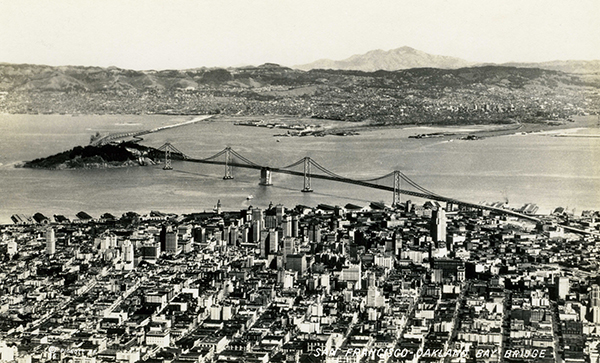
(Oakland-San Francisco Bay Bridge - shortly after it's completion in 1936 - San Francisco is in the forefront, Oakland is in the background, with Mt. Diablo seen hovering over the East Bay)
Sometime after, Lydia started going out again and living a little. She went to some dances in Richmond and Oakland. At these dances, she met a man named Bill Murphy, who was living in Oakland, with his mother, who also had passed on around this time, in 1949. Bill was likely helping take care of his mother, along with his siblings, whom some also lived in the area. Bill was a confirmed bachelor. He never had married (that we are aware of) and did not have any children.
By meeting Bill Murphy, Lydia's life would take on a whole new twist. Not only was Bill Murphy a nice and gentle man, but he also owned lots of land in the town of Brentwood, land that was very valuable to the area. Lydia and Bill were married in 1950. With this marriage, Lydia had to leave behind her home in Richmond and move to the country with Bill. However, Bill let her design her own home and let her have it built custom to her own specifications. The home was completed around the end of 1950 and 1951.
From now on, Lydia was not without want. She was going to be well taken care of, and the kindly Bill Murphy also took on in helping raise James.
With a new home and beautiful land to wake up to everyday, Lydia was not one to keep this to herself. She opened her home to all. She had a basement that was as large as the main house floor, which is where she'd often invite all her children and grandchildren, cousins and nieces and nephews, sisters and brothers - and of course, her lodge friends. Also, as she got more familiar with the area, she quickly became good friends with the locals. There were a few fun eccentrics living nearby her. One was Mrs. Edith Ordway. Mrs. Ordway was a wealthy San Franciscan who purchased land in the Los Vaqueros area (behind the Black Hills of where Lydia lived). However, Mrs. Ordway loved to play cowgirl and shoot off her rifle when she had the chance, you know, just for fun.
Edith Ordway in 1938 at Ordway Ranch
Another family she also befriended were the Cakebread family. The Cakebreads owned land near Lydia and became close to her as well.
The following photos demonstrate that parties were even happening before the house was finished, circa 1951 (note the plaster on the drywall and unfinished windows).
Hank Wolf with Ronnie Wolf, Bill Murphy, Doris Jean Wolf with Diane Connors, Joyce Wolf, Annette Roehm and Bud Wolf.
The Ranch almond trees, looking towards what is now Round Valley Regional Park, circa 1950's.
When Bill and Lydia lived on the ranch together, Bill took care of the Ranch, using the tractors and corralling cattle, keeping chickens in the coops, maintaining the old big Barn, the tack house, bunk house and various other duties of the land. Lydia settled into a somewhat retirement, taking up new and enjoyable hobbies - learning to cook and design complicated cakes and decorating them herself. Her wedding cakes were used in both my Aunt's and mother's weddings. They were some of the most elaborate wedding cakes I ever saw. Lydia also enjoyed selling greeting card sets that she mail ordered. She hung onto many of the sets that never got sold.
During this time, Lydia also started to travel outside of California more. She went back to North Dakota several times to visit with her family and her daughter, Doris, who had recently been diagnosed with Multiple Sclerosis. Doris would pass on in 1963, at the young age of 48.
Lydia is second from right (with Sister Sophie next to her). Sophie's family is pictured here in North Dakota. Christina Herr is standing with scarf on, circa 1959.
Lydia is in the background, in white, with her oldest daughter Doris to the left of her. Annette Roehm (now Purviance), looking at camera in front. Daughter Penny is behind her. Valley City, North Dakota, 1959.
While on this trip, Lydia and the family stopped into Montana to visit some of the Roehms, who were living there at the time. When visiting with them, they were deciding if they should stay or leave, but Lydia was adamant they stayed, having some kind of premonition that the alternative would not be good. So, they stayed overnight with cousin Arlys [Roehm] Hunt to have a large earthquake wake them up at 12:30 am. It ended up being a very large earthquake in Hebgen Lake, MT which put homes underwater and killed over 20 people. Lydia and the others were very surprised, because they would have been traveling right through that route if they had not stayed the night. Many believed Lydia had a sixth sense due to this. This wasn't the only time she had such a premonition. There were to be more.
Lydia is second from right. Lenora Roehm (her daughter in law) - Mrs. George Roehm is behind Lydia and Carol Roehm, was also her daughter in law - Mrs. Alwin Roehm, is first from front left)
George Roehm Jr., Lydia Roehm and Alwin Roehm.
Lydia is in the front, second from right, circa 1962.
Lydia, circa 1962, age 66.
Lydia is second from left on the top photo, circa 1962.
You'd think that by now, well into her 60's, Lydia would have slowed down a bit, but she was just revving up. The late 1960s and most of the 1970s, she'd spend more time on the road than at home. She went and saw many family members, most who'd she see for the last time.
Part 3 of this installment on this incredible "Fearless Female" will look into Lydia's many travels with her youngest daughter Annette (my grandma) and Lydia's last days here on earth.
Source: Visit Lisa Alzo's great blog, which is the source for the Fearless Female blog prompt, http://www.theaccidentalgenealogist.com/
Wednesday, March 18, 2015
Fearless Females - {Birthday Edition}: Lydia Herr Roehm Murphy - Born March 20th - Part 1
A special lady in our family was born on this day; the matriarch of our family, shall we say. So many people have always had such wonderful things to say about Lydia. She has been remembered fondly by many family members and friends alike, and boy, did she have friends! She was truly someone special, she gave of herself in so many ways and was very generous of her time and monetary donations to those in need.
Lydia Herr (she did not have a middle name), was born on an early Spring day on March 20th, 1896. She was a first generation American in her family, as both of her parents who were of German descent, came to America from Russia in their youth.
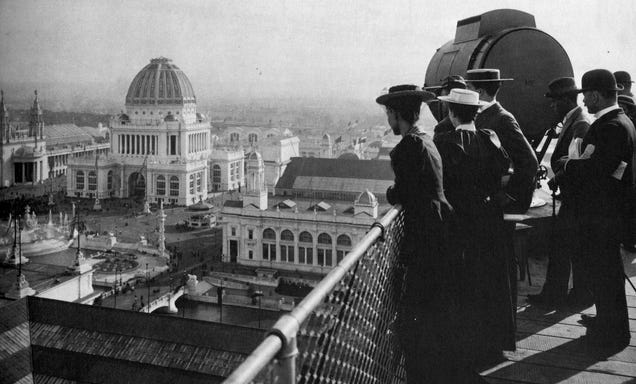
Her parents were said to have met at the Chicago World's Fair in 1893, as seen below:
At the moment, there is no record of their marriage, however, they were married sometime between their meeting and Lydia's conception, probably sometime in mid-1895.
Jacob and Christina Herr had their first born in Ashely, North Dakota, just a few miles from where they'd end up making a permanent home in Wishek.
When Lydia was born, she was jaundice. Someone thought quick on their feet and put her inside their kitchen oven. Lydia survived!
Here is a picture of baby Lydia, the oldest known picture we have of her and her parents, from circa 1897:

Even though we are not 100% sure if putting Lydia inside the oven would have been the cause of this for her, but she had poor eyesight her whole life, and began wearing glasses at a very early age.
Lydia grew up on the family farm in Wishek with her siblings, helping out on many of the chores, such as milking the cows, feeding the chickens and many other household duties. She also made time for school, but only graduating from the 8th grade.
Here's a few photos to capture these moments:
Lydia (back middle), with Martha, Sophie and baby brother Arthur, circa 1904.
%2C%2B1904%2C%2BWishek%2C%2BND.jpg)


 Lydia taking down the frozen laundry outside. She would often do this and then take it in and let it dry on a rope during the winter, circa Winter of 1914-1915. George wrote on the back of this photo, saying he took it and caught her by surprise. I thought that was kind of cute that he did that.


The second part of Lydia's life only gets better. Her life is too interesting to keep it all contained in one post - so I will resume the second half on the anniversary of her actual birthday, March 20th.
Source: Visit Lisa Alzo's great blog, which is the source for the Fearless Female blog prompt, http://www.theaccidentalgenealogist.com/
Lydia Herr (she did not have a middle name), was born on an early Spring day on March 20th, 1896. She was a first generation American in her family, as both of her parents who were of German descent, came to America from Russia in their youth.
Her parents were said to have met at the Chicago World's Fair in 1893, as seen below:
At the moment, there is no record of their marriage, however, they were married sometime between their meeting and Lydia's conception, probably sometime in mid-1895.
Jacob and Christina Herr had their first born in Ashely, North Dakota, just a few miles from where they'd end up making a permanent home in Wishek.
When Lydia was born, she was jaundice. Someone thought quick on their feet and put her inside their kitchen oven. Lydia survived!
Here is a picture of baby Lydia, the oldest known picture we have of her and her parents, from circa 1897:
Even though we are not 100% sure if putting Lydia inside the oven would have been the cause of this for her, but she had poor eyesight her whole life, and began wearing glasses at a very early age.
Lydia grew up on the family farm in Wishek with her siblings, helping out on many of the chores, such as milking the cows, feeding the chickens and many other household duties. She also made time for school, but only graduating from the 8th grade.
Here's a few photos to capture these moments:
Lydia (back middle), with Martha, Sophie and baby brother Arthur, circa 1904.

Lydia grew up in this home in Ashley, ND. When she was around 8 or so, she daringly climbed up the windmill all the way to the top. I have a feeling she got in trouble for doing so!
Lydia (on right) with a friend, Summer of 1914
Lydia with her cousin, Donald Herr, circa 1914
Lydia working outside, doing laundry and farm work, circa 1914-1915
Lydia only stood 4'11'' and had hazel eyes with light brown hair.
Lydia was a photographer and developed her own photos in her own darkroom. One postcard I found verifies this info, as the sender of the card asked how Lydia's photography was going. And, one obvious piece of evidence is the amount of photographs she kept and took! The little Brownie camera must have inspired her!
She was also a master seamstress, working not only on her own clothes, but also her siblings and later her children's and husbands. She would often ask her family what they'd like to have sewn, and she'd make it special for them.
Lydia started working at her father's mercantile store in town, which was a large store that carried everything from clothing to eggs. It even had a soda fountain! Lydia worked in the dry goods section, often dealing with materials and sewing items. She worked mainly as the seamstress and became friends with many people in town. She was friends with Lucy Roehm, who came from a family of Germans who were from Northern Germany and immigrated out of Berlin.
Lucy had an older brother named George, who became acquainted with Lydia, most likely during this time. Lydia and George went to dances together and Lodge meetings. Somewhere along the way, they must have become smitten with one another, because on December 25th, 1914, they were married. There were rumors that some boys were after Lydia because she came from a wealthier family than others in town (mostly due to her father owning part of the Herr Mercantile Store).
George was a tall, dark and handsome man, with blue eyes and dark brown hair, with a nice tan. His rugged good looks complimented Lydia's softer, lighter features.
Here are a few photos of them during their courtship and after their marriage.
George after a day's hunt, Wishek, ND, circa 1914.
George and Lydia on far left, with friends and family (they look like they are Roehms)
George taking a break while building, circa 1914.
George bailing hay, circa 1914 (I think Lydia took these photos of him because she was truly in love with him and wanted to have something to remember him by - if it were not for her, we may not have many younger photos of either one of them)
George and Lydia in center, with friends in woods, circa 1914
Lydia and George on their wedding day, December 25th, 1914. Lydia designed and made her own wedding gown.
Shortly after their marriage, George worked hard and quickly to get a home built for them; one that would provide in creating a family and a place of rest. And, that family started quickly - George and Lydia had their first born daughter, Doris, in September of 1915.
Lydia & Doris, about 1916
Martha Herr Werre, George Roehm and baby Doris Roehm, on a boat, circa Winter of 1915/1916.
Doris Roehm and Joyce Roehm, circa 1918 (I think Lydia was pregnant with her daughter Izetta, based on her stance and the shape of her dress)
George and Lydia would have a total of seven children: Doris, Joyce, Izetta, George Jr, Alwin, Annette and James, the last being born in 1942.
During the latter half of the 1910's, America was facing a World War. George was drafted, however, he was able to get out of the draft, due to being the sole supporter of his growing family. His brothers, though, all served.
During the 1920's, the family prospered and continued to grow, however, at the end of 1929, George and Lydia, like all Americans, could not avoid the effects of the Great Depression. Even Lydia's inheritance from her father's death in 1926, could only last them so long. However, Lydia's philanthropic side used her money to help put George's sister, Lucy, through nursing school.
At the beginning of 1929, came the birth of their last daughter, Annette (my grandmother). Annette would be their last born child for 13 years, until James "Jimmy" Roehm was born in 1942.
During the Great Depression, the family scraped on by, but work seemed to finally have ran out for George by the time 1942 came around. He had been a superintendent on building the Wishek Civic Auditorium for the WPA, but that wasn't enough to get them through the end of the Depression, especially in a town that was not quite growing at the momentum that America's larger cities were growing.
Like many did during the Depression and during the onset of World War II, the Roehms went west to California. Both of their sons were of age to be drafted. Alwin was drafted very much right out of graduating High School in 1942. George Jr was 21 when he was drafted. Alwin went to California to work for a bit and possibly train. During this time, he sent money home to help prepare the family to come to California. Finally the time came. Lydia had most of their belongings put on a train and sent to California. They then drove to California and lived temporarily with their older daughter, Izetta, until their home was done being built in Richmond. Sometime in 1943, the family had a new home in a new neighborhood in Richmond, CA.
Richmond was one of the main hubs of ship building during World War II. The Kaiser shipyards are where George took up helping build the many ships that they produced. "Rosie the Riveter" was a famous term for the women who also worked in these ship yards.
Here are a few photos of the family slightly prior and after their move to California:
George Jr, George Sr, Annette and Lydia, circa 1940. Not too many years away from leaving the only home they knew to the sunny shores of California for a new beginning.
Making it in California, Lydia and George's children have grown up and began families of their own - Alwin, Joyce and Doris with father George, circa 1944.
Ross Sr, unknown, George Roehm and his brother Richard Roehm, who was a chemist in Anaheim, CA.
Joyce Wolf, Doris Thvedt, Izetta Purviance with Cheryl Thvedt - George Sr is holding Ross Purviance, Jr.
California must have felt a million miles away for Lydia and George, but they adapted fairly easily to the beautiful, mild weather of the Bay Area, making a home in the San Francisco -East Bay Area.
Source: Visit Lisa Alzo's great blog, which is the source for the Fearless Female blog prompt, http://www.theaccidentalgenealogist.com/
Subscribe to:
Posts (Atom)